
PUR Edgebanding Adhesive Selection Guide: Selection Methods Based on Substrate, Line Speed, Open Tim
Product Overview
Product Highlights
Applications
Product Parameters
Notes
Product Details
Which furniture edge banding scenarios are suitable for PUR edge banding adhesives
PUR edge banding adhesive is a reactive polyurethane hot melt adhesive. During application, coating and bonding are first completed in the hot melt state, followed by continued reaction and curing with trace moisture in the air or from the substrate. Compared with conventional thermoplastic hot melt adhesives, its core value lies not only in initial tack speed, but also in the heat resistance, moisture resistance, cleaner resistance and durability after curing. For custom furniture, kitchen cabinets, bathroom cabinets, door-wall-cabinet integration, laboratory furniture, commercial space furniture and high-end panel furniture with demanding glue line appearance requirements, PUR edge banding adhesives generally meet long-term use requirements more readily.
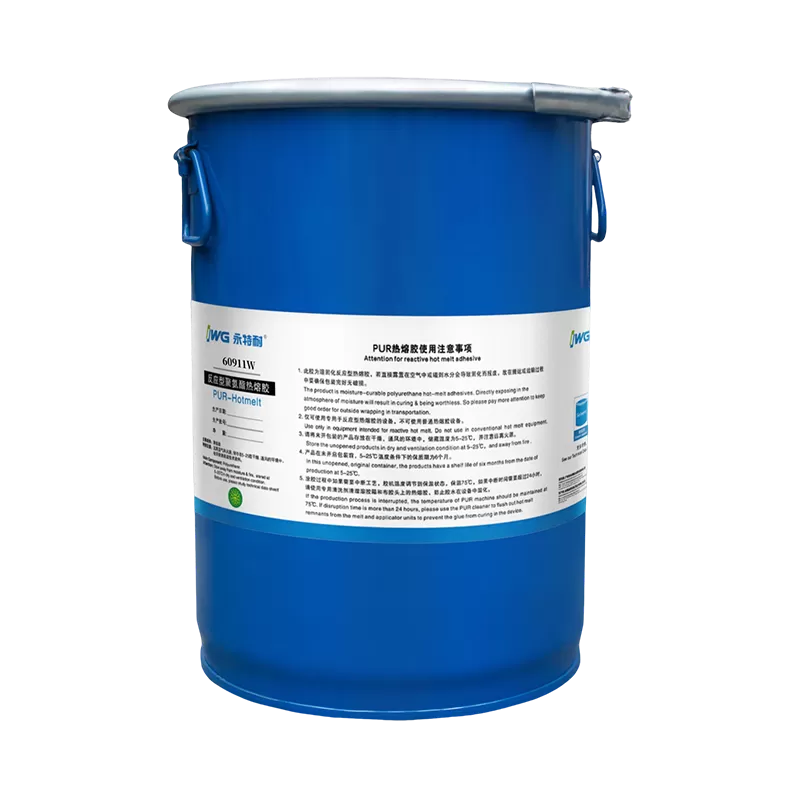
During actual product selection, do not judge solely by the category name "PUR". Different PUR edge banding adhesives do not have exactly the same viscosity, open time, initial tack, application amount, applicable line speed, cleaning method and equipment sealing requirements. Before introduction, the factory should first clarify the substrate, edge band, edge banding machine structure, melting system, ambient humidity, production rhythm and target test items, and then confirm the specific model through trial validation. The PUR edge banding hot melt adhesive series from IWG WINLONG is mainly intended for furniture edge banding, profile wrapping and wood bonding scenarios. For product details, please refer to PUR edge banding adhesive 60911W.
Core differences between PUR and EVA edge banding adhesives
EVA edge banding adhesive primarily relies on cooling to form a thermoplastic adhesive layer. Its advantages include widespread application, low equipment requirements, relatively simple adhesive change and cleaning, and easily controllable overall cost. After initial cooling and solidification, PUR edge banding adhesive continues to undergo moisture-curing reaction. Once curing is complete, the adhesive layer is no longer easily softened again by high temperatures like ordinary thermoplastic adhesives, thus offering more advantages in heat resistance, moisture resistance, water vapour resistance and chemical cleaning resistance.
If the products are mainly used in ordinary indoor dry environments, the edge band material and panel are stable, and the orders prioritize efficiency and cost, EVA edge banding adhesive remains a common choice. If the products are intended for kitchens, bathrooms, coastal humid environments, high-temperature transport, export containers, handleless door panels, narrow-edge or dark-colour high-gloss door panels, the value of PUR edge banding adhesive becomes more apparent. During selection, it is not advisable to simply interpret the two as "which one is better"; rather, a comprehensive judgment should be made based on the end-use environment, appearance grade, rework cost, customer complaint risk and equipment conditions.
Process parameters that must be confirmed before selection
Before selecting a PUR edge banding adhesive, it is recommended to confirm at least nine categories of information: panel type, edge band type, edge band thickness, edge banding machine brand and application structure, line speed range, temperature of the glue pot or premelting system, pressure roller pressure, workshop temperature and humidity, and the testing or customer acceptance standards the finished product needs to pass. When these parameters are missing, suppliers can only provide general direction and cannot guarantee stable results from a single trial.
Regarding panels, it is necessary to distinguish among different substrates such as particleboard, MDF, multi-layer board, solid wood particleboard, eco-board, fire-retardant board and moisture-resistant board. Regarding edge band material, it is necessary to distinguish among PVC, ABS, PP, CPL, acrylic, high-gloss, skin-touch film, wood veneer and thin edge band. The surface energy, back-coating treatment and thickness of different materials will affect wetting, initial tack and final peel strength. For dark-colour or mirror high-gloss materials, special attention should also be paid to glue line thickness, contamination, stringing and indentation issues.
How to match line speed, open time and application temperature
The faster the line speed, the shorter the time for the adhesive layer from application to pressing, which typically requires a product with faster initial tack, more thorough wetting and better thermal stability. When the line speed is slower or the open equipment distance is longer, it is necessary to prevent the adhesive layer from losing its bondable window too early. Regarding the generic search term "PUR edge banding adhesive manufacturer recommendation" noted in audits, what users truly want to solve is often not a list of manufacturers, but "Which adhesive exactly suits my equipment and materials?" Therefore, articles and product pages should continuously explain the relationship between line speed, open time, application temperature and materials.
Higher application temperature is not always better. Too low a temperature may lead to insufficient melt, poor wetting and inadequate initial tack; too high a temperature may accelerate adhesive aging, increase stringing, affect colour stability and raise the difficulty of equipment cleaning. For PUR adhesive, attention should also be paid to glue pot sealing, nitrogen protection or drum supply methods to prevent premature reaction from prolonged exposure to humid air. Before formal mass production, the stability after trimming, cutting and long-term placement, as well as glue line appearance and peel performance, should be confirmed through small-batch trial production.
Points of attention for different edge band materials
PVC and ABS edge bands are the most common materials in panel furniture. Selection focuses on back-coating stability, thickness, surface treatment and pressing window. Thick edge bands have higher requirements for initial tack and pressing pressure, while thin edge bands more readily expose glue line and contamination issues. CPL, wood veneer or special decorative materials have higher requirements for wetting and resistance to subsequent processing, and trials should be conducted in combination with sanding, trimming, polishing and cleaner usage conditions.
For high-gloss panels, skin-touch panels, dark-colour panels and narrow-edge door panels, glue line appearance is a key indicator. PUR edge banding adhesive can help achieve a finer and more stable glue line, but only on the premise that equipment precision, adhesive application amount and edge band back-coating can all cooperate. If the equipment exhibits panel runout, pressure roller wear, unstable tooling or fluctuation in application amount, simply switching adhesive may not necessarily solve appearance problems; the mechanical condition needs to be adjusted simultaneously.
How to verify heat resistance, moisture resistance and cleaner resistance requirements
In the past, many furniture factories only conducted immediate peel strength tests, but for PUR edge banding adhesive, cured performance is more important to observe. It is recommended to set up verification items after trial, such as room temperature placement, thermal cycling, damp heat, thermal shock, water vapour contact, cleaner wiping and edge band peeling. Different customers and export markets may have different acceptance methods, so judgment should not rely solely on the feel immediately after the board comes off the line.
In scenarios such as kitchens, bathrooms, schools, apartments, hotels and commercial spaces, once edge banding quality fails, the rework cost will far exceed the adhesive price difference. For such projects, it is recommended to prioritize PUR edge banding adhesive and to incorporate trial records, process parameters, batch records and exception handling methods into mass production standards. When corporate qualifications, certificates, test reports or patent information are required, please refer to the IWG WINLONG Verification Center.
Equipment cleaning and production management considerations
PUR edge banding adhesive places higher demands on equipment management. Before production, confirm the compatibility of the adhesive drum, glue pot, glue roller, nozzle, pipework and cleaning agent. During downtime, handle residual adhesive according to the requirements of the equipment manufacturer and adhesive supplier. When switching between different types of adhesive, avoid mixing. If the workshop humidity is high or downtime is prolonged, special attention should be paid to sealed storage to reduce premature reaction of the adhesive.
For production management, PUR introduction is not simply a matter of "switching to a different adhesive," but rather establishing a stable process window. It is recommended to record the application temperature, line speed, pressure roller pressure, ambient temperature and humidity, edge band batch, panel batch, appearance results and peel results for each trial. The more complete the data, the easier the subsequent traceability and optimization. For enterprises with multiple sites and multiple shift production, a unified recording format is more valuable than a single experience.
Recommended process for mass production introduction
The recommended process can be divided into five steps. First, collect material and equipment parameters, and clarify the target product and usage environment. Second, select one or two candidate models and conduct trials on standard panels and actual edge bands. Third, perform immediate appearance checks, trimming checks, peel tests and re-tests after placement. Fourth, carry out small-batch trial production to observe stringing, adhesive accumulation, contamination, pressing stability and cleaning conditions during continuous production. Fifth, create a mass production process card to fix the temperature, line speed, application amount, downtime handling procedure and test items.
If a long-term decision is made based only on the results of a single trial, changes in seasons, humidity, material batches and equipment conditions can easily be overlooked. A more prudent approach is to introduce PUR edge banding adhesive as a systems engineering project, with parameters jointly confirmed by the adhesive supplier, equipment personnel and production supervisor. Based on the panel, edge band, equipment, line speed and target market, IWG WINLONG can provide more specific model recommendations and application support.
Frequently Asked Questions
Is PUR edge banding adhesive always better than EVA edge banding adhesive?
No. PUR is more suitable for projects with higher requirements for heat resistance, moisture resistance, glue line appearance and long-term stability; EVA remains suitable for a large volume of ordinary interior furniture and cost-sensitive orders. The key is to select based on the scenario.
Can PUR edge banding adhesive directly replace the original EVA adhesive?
Direct replacement is not recommended. It is necessary to confirm whether the equipment supports PUR, whether the glue pot sealing and cleaning methods are compatible, and to determine the temperature, line speed and pressing parameters through trials and small-batch trial production.
Why does the same PUR adhesive perform differently in different factories?
Panels, edge band back-coating, equipment precision, application amount, ambient humidity, line speed and operating habits all influence the results. The same adhesive can exhibit different stability under different process windows.
What information is most necessary to provide during selection?
At a minimum, provide the panel type, edge band material and thickness, equipment model, line speed, application temperature, workshop temperature and humidity, target test requirements and the problems currently encountered.