
























FAQ - Common Problems and Solutions of Soft Glue Used in Bag Spring Splicing Process
Table of Contents
I. Poor Bonding Issues (Audience: Flexible Glue Technicians / Gluing Machine Operators / Pocket Spring Machine Operators / Workshop Production Supervisors)
II. Squeegee Coating Issues (Audience: Gluing Machine Operators / Workshop Production Supervisors)
III. Stringing Issues (Audience: Flexible Glue Technicians / Gluing Machine Operators / Workshop Production Supervisors)
I. Poor Bonding Issues (Audience: Flexible Glue Technicians / Gluing Machine Operators / Pocket Spring Machine Operators / Workshop Production Supervisors)
【Q1】What are the common causes of poor bonding?
【A1】【Summary of Poor Bonding Causes】Based on on-site process analysis, poor bonding mainly results from the following five categories of factors:
1. Insufficient glue supply — glue spread amount is lower than the process minimum of 0.55g per pocket spring, resulting in discontinuous glue layer on the bonding surface;
2. Excessively slow glue curing speed — affected by high workshop temperature (above 35℃), residual heat of quenched springs before pocketing or increased production speed, the glue fails to form initial tack within the specified time;
3. Insufficient open time of glue — the manual operation window is inadequate under semi-automatic working conditions, and the glue skins over before the spring strips are placed;
4. Improper coil diameter setting of pocket springs — the second coil of high-compression springs is too large, stacking mutually on the bonding surface after pocketing and hindering uniform glue application;
5. Improper arrangement parameters for bonding — the head and tail ends of the spring unit are set too tightly, causing extrusion displacement; or inconsistent upper and lower speeds of the feeding conveyor lead to skewed pocket spring feeding.
Remarks: In addition, the two glue hoses on the same gluing machine may have power differences, resulting in inconsistent glue dispensing on both sides. This factor needs to be checked simultaneously during equipment commissioning.
【Q2】What are the common manifestations of poor bonding?
【A2】Poor bonding is mainly manifested as insufficient bonding strength between pocket springs, with separation or loosening between spring strips. During the service of the mattress spring unit, the bonding force between adjacent pocket spring strips is low, which easily causes separation and affects the overall stability and service life of the spring unit. Poor bonding can usually be found by visual inspection — uneven glue distribution at the bonding position, incomplete bonding surface or obvious gaps.
【Q3】How to solve poor bonding caused by insufficient glue dosage?
【A3】The recommended glue spread amount for pocket spring splicing is 0.55-0.65g per pocket spring (4 glue lines). When the glue dosage is insufficient, adjust by the following methods:
l Properly increase the air pressure of the gluing machine to raise glue output;
l Properly raise the temperature of glue hoses and glue guns to improve glue fluidity;
l Replace glue nozzles with appropriate bore diameters to match process requirements;
l Clean the filter screen of the gluing machine to ensure unobstructed glue passage.
【Q4】What causes slow glue curing speed and how to fix it?
【A4】Common causes of slow glue curing speed include:
l High ambient temperature in the workshop (above 35℃), affecting glue cooling and curing;
l Inadequate cooling of springs (especially steel wire with wire diameter above 2.2mm) after quenching before pocketing, resulting in high internal temperature of the spring unit;
l After the production speed (feeding rows per minute) is increased, the glue temperature is not adjusted synchronously in a timely manner.
Solutions:
l Lower the adhesive temperature — properly reduce the working temperature of glue hoses and glue guns;
l Strengthen heat dissipation of substrates — for example, use fans to accelerate the cooling of pocket springs;
l Extend spring pushing and pressing holding time — it is recommended to add 0.1 second holding time on Lianrou gluing machines.
【Q5】How to adjust if insufficient glue open time affects manual operation efficiency?
【A5】Insufficient glue open time usually manifests as: on semi-automatic machines, the efficiency of manually placing spring strips decreases, and the glue cures prematurely before bonding is completed.
Solution: Properly increase the set temperature of the gluing machine (including glue tank, glue hoses and glue guns), extend the open time of the glue and reserve sufficient operation window for manual work.
【Q6】How to optimize when improper coil diameter setting of pocket springs affects bonding quality?
【A6】After springs are pocketed by the high-compression spring machine, the second coil is often presented at the top or bottom. When the coil diameter is set too large, steel coils will stack with each other, affecting the uniform distribution of glue on the bonding surface and the bonding effect.
Solution:
l Optimize the coil diameter setting of pocket springs and adjust parameters of the high-compression spring machine to avoid stacking of the second coil caused by excessive coil diameter during bonding;
l Adjust spring machine parameters to ensure a uniform pocketing angle of springs and maintain consistency.
【Q7】How to adjust when improper bonding arrangement of pocket springs causes spring unit deformation?
【A7】The first and last rows of pocket springs of the spring unit are prone to deformation, mainly due to two reasons:
l Overly compact spring unit setting — displacement occurs due to interaction force when the front and rear rows of pocket springs are bonded;
l Inconsistent upper and lower speeds of the pocket spring feeding conveyor, resulting in skewed pocketing.
Solutions:
l Adjust the spring core diameter according to the tightness of the spring unit to prevent the first row of pocket springs from being pushed and displaced during bonding;
l Ensure consistent upper and lower speeds of the feeding conveyor, and check the levelness and verticality of the spring pushing plate.
II. Squeegee Coating Issues (Audience: Gluing Machine Operators / Workshop Production Supervisors)
【Q8】What are the main causes of squeegee coating problems?
【A8】Squeegee coating issues are generally attributed to the following four types of equipment and process factors:
1. Spray position deviation — misaligned nozzle orientation, glue lines falling outside the designated bonding area, and pocket springs scraping directly against the glue lines during spring pushing;
2. Asynchronous conveying and spring-pushing speed — mismatch between conveyor speed and spring travel speed, causing relative movement and scraping between pocket springs and glue lines;
3. Loose PK cotton substrate — non-woven fabric not tightly attached to the conveyor, creating wrinkles or offset during operation and leading to inaccurate glue line positioning;
4. Excessive machine downstroke — compression distance exceeding 1 cm. During spring pushing, pocket springs squeeze the glue lines on the upper PK cotton and scrape them flat.
【Q9】What are the common symptoms of squeegee coating?
【A9】Squeegee coating means the glue on the substrate surface is scraped flat by pocket springs — the glue lines are physically scraped before bonding, resulting in uneven glue distribution or insufficient glue volume, which directly weakens bonding strength.
【Q10】How to adjust when abnormal spray position causes squeegee coating?
【A10】Abnormal spray position leads to scraping between pocket springs and glue lines during spring pushing, flattening or displacing the glue.
Solution: Adjust nozzle orientation and calibrate the dispensing position so that glue lines are sprayed accurately onto the designated bonding zone.
【Q11】How to resolve squeegee coating caused by asynchronous conveyor and spring-pushing travel?
【A11】When conveyor speed does not match spring-pushing speed, pocket springs move relative to the glue lines during conveyance and trigger scraping.
Solution: Adjust conveyor speed and spring-pushing speed to keep them synchronized.
【Q12】How to fix squeegee coating caused by PK cotton not adhering tightly to the conveyor?
【A12】If PK cotton (substrate non-woven fabric) is not tightly attached to the conveyor, it will loosen or wrinkle during operation, shifting glue line positions and resulting in squeegee coating.
Solution: Hang weights at the PK cotton roll or add pressing devices to tension the PK cotton substrate and ensure it lies flat against the conveyor surface.
【Q13】How to adjust when improper machine downstroke setting causes squeegee coating?
【A13】An excessively large downstroke setting will cause pocket springs to scrape against the glue lines on the upper PK cotton during spring pushing.
Solution: Set a reasonable downstroke distance; the recommended range is generally 0.5–1 cm.
III. Stringing Issues (Audience: Flexible Glue Technicians / Gluing Machine Operators / Workshop Production Supervisors)
【Q14】What mainly causes stringing?
【A14】Stringing is usually caused by the following four categories of glue property and equipment parameter factors:
1. Excessively high glue viscosity — low adhesive temperature reduces fluidity and raises viscosity; residual glue cannot break quickly at the end of the dispensing stroke;
2. Structural limitation of the spot spray valve — with spot spraying, glue does not separate cleanly each time the nozzle valve closes, easily leaving filament residues;
3. Excessive glue line speed — after spraying finishes, trailing glue is flung toward both sides of the spring unit due to fast gun movement and accumulates;
4. Overlong spraying travel — the end of the glue line exceeds the actual width of the spring unit, and excess glue is dragged to both sides at the stroke endpoint.
【Q15】What are the common symptoms of stringing?
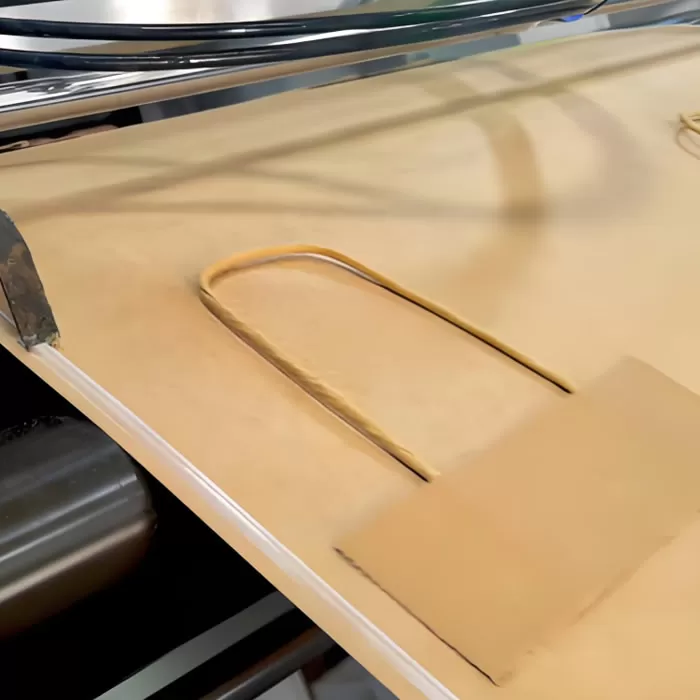
【A15】Stringing appears as filamentous glue residues during or after dispensing, mostly accumulating on both sides of the spring unit. Stringing impairs product appearance and may also cause glue waste and equipment contamination.
【Q16】How to solve stringing caused by improper glue viscosity?
【A16】When adhesive temperature is reduced, glue fluidity drops and viscosity rises. At the end of the dispensing stroke, high-viscosity residual glue cannot break quickly and creates stringing.
Solution:
l Adjust adhesive temperature properly to maintain glue within the suitable working viscosity range;
l Select hot melt adhesive products better matched to the equipment process.
【Q17】How to optimize stringing caused by spot spraying?
【A17】While spot spraying saves glue, incomplete glue separation occurs every time the nozzle valve closes, which easily triggers stringing.
Solution: Switch to line spraying. Continuous spraying reduces stringing issues brought by frequent valve opening and closing.
【Q18】How to adjust stringing caused by excessive spraying speed?
【A18】After spraying finishes, trailing glue is flung outward by fast gun movement and builds stringing deposits along the edges of the spring unit.
Solution: Lower the spraying speed appropriately so the glue can separate cleanly at the end of the stroke.
【Q19】How to adjust stringing caused by overlong spraying travel?
【A19】When the set glue line length exceeds the actual width of the spring unit, excess glue is dragged to both sides at the stroke endpoint and forms stringing buildup.
Solution: Adjust the spray distance compensation parameter to precisely match the spraying travel to the actual spring unit width.
·The technical parameters and process suggestions in this guide are summarized based on laboratory test data and long-term practical production experience, intended to help users find suitable working methods. Since end users' production conditions are beyond our control, our company shall not be liable for results affected by each user's own production environment. In all cases, it is recommended that specific product selection and process parameters be tested and verified against your actual production line conditions. For further technical support, please contact our sales or technical team.


